
What Is Included in a Concert Videography Package?
When people ask what is included in a concert videography package, they usually want a clear answer to a practical question: what exactly will be filmed, how it will sound, what will be edited, and what files will be delivered afterward.
In most cases, a concert videography package includes four core parts: pre-event planning, on-site filming, audio capture, and post-production. The details can vary a lot. One package may be built for a simple archival recording. Another may be designed for public release, promotion, or long-term portfolio use.
That difference matters.
A chamber ensemble in Budapest, a jazz group in Vienna, and a venue organizing a formal concert series may all ask for “concert video,” but they may need completely different results. A full-length concert recording, a highlight edit, and short promotional clips are not the same deliverable. A good package makes that clear before the event starts.
Quick Answer
A concert videography package usually includes planning, filming, audio capture, editing, and delivery of agreed outputs such as a full concert video, a shorter highlight edit, or promotional clips. What changes from one package to another is usually the number of cameras, the quality and method of audio capture, the amount of editing, the turnaround time, and the number of final deliverables.
What a Concert Videography Package Usually Includes
A proper concert videography package is more than camera coverage during the performance. It is a production workflow with defined outputs.
Pre-event planning
This is the part many clients do not see, but it affects everything.
Before the concert, a professional concert videographer usually confirms the venue, access time, performance schedule, expected duration, stage layout, ensemble size, lighting conditions, audience setup, and any movement restrictions. In concert halls, churches, cultural institutions, and formal event spaces, this matters because filming has to respect the event, the acoustics, and the audience experience.
The planning stage should also define the purpose of the recording. Is the goal archive documentation? A polished public release? A short promo edit for applications, booking, or social media? The answer affects camera placement, shot strategy, audio approach, and editing priorities.
On-site filming
This is the visible part of the package, but it is only one part of the final result.
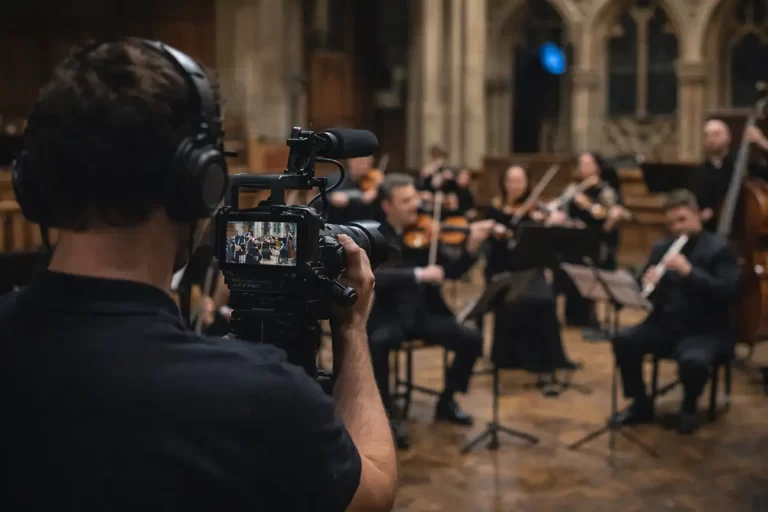
A concert videography package usually includes setup before the performance, filming during the event, camera operation, monitoring, and practical adaptation to the venue. Depending on the scope, this may involve one camera or a multi-camera setup.
For a simple documentation job, a fixed and well-positioned single camera may be enough. For chamber music, orchestral concerts, jazz ensembles, or performances intended for public presentation, multi-camera filming is often the better choice. It allows the edit to follow the structure of the performance, capture interaction between players, and keep the final video more engaging without becoming intrusive.
Audio capture
In concert work, audio should never be treated as an afterthought.
Many people first think about cameras, but the sound often determines whether the finished result is merely acceptable or genuinely useful. A concert videography package may include a basic synced audio track, a stereo music recording, a feed from the venue sound system, room ambience, or a combination of methods.
The important point is clarity. “Video included” is vague. “Multi-camera filming with synced professional audio capture” is clear. For classical music, chamber performances, jazz concerts, and other acoustic events, audio quality is central to whether the final recording is worth publishing, sharing, or archiving.
Add Your Post-production Text Here
This is where the raw material becomes a finished deliverable.
Post-production usually includes media handling, file backup, syncing cameras and audio, trimming, editing, export, and delivery. In some cases, it also includes titles, simple color correction, basic sound balancing, and preparation of different output versions.
A well-defined package should make it clear whether the client is receiving only a clean full-concert edit, or whether the scope also includes shorter promotional edits, clip extraction, or social-ready exports.
The Most Common Concert Video Deliverables
The phrase “concert videography package” becomes meaningful only when the deliverables are clearly defined.
Full concert recording
This is the long-form master of the performance. It is often the most important deliverable for orchestras, chamber groups, venues, conservatory applications, grant documentation, repertoire records, and formal archives.
A full concert recording is usually built for completeness. It documents the performance as it happened and is often the foundation for later use.
Highlight video
A highlight video is a shorter, more selective edit. It is not just a shortened full concert. It is a separate editorial product built to present the event in a concise and watchable way.
For many musicians and organizers, this is one of the most useful outputs because it can be placed on a website, shared with presenters, used in a portfolio, or sent to partners who do not have time to watch a full concert.
Short promotional clips
Short clips are often the most practical promotional add-on after a concert.
These may include teaser videos, short extracts for announcements, vertical social clips, or short edits for artist pages and venue promotion. These clips are especially useful for musicians, ensembles, festivals, and cultural organizations that want to extend the value of one performance beyond the live event itself.
Separate extracts or movement-based exports
Sometimes the client does not only need one full video. They may also need separate pieces exported individually. For example, a recital program may need separate files per work, per movement, or per featured artist.
This should be agreed in advance because it adds editorial work and delivery time.
Need a clearer idea of what level of coverage fits your concert?
You can review the broader services and look at the portfolio first. That usually makes it easier to decide whether you need simple documentation, a multi-camera concert film, or a package that also includes shorter promotional edits.
What Changes From One Package to Another
Not every package includes the same scope. The most important differences usually come down to the following factors.
Add Your Heading Text Here
A single-camera package is simpler and usually better suited to straightforward documentation.
A multi-camera package is often a better fit when the performance is visually important, the ensemble interaction matters, or the final result is meant for public presentation. This is especially true for chamber music, orchestra work, conductor-led performances, and jazz concerts where visual interplay is part of the experience.
Audio method
Some packages include only a clean synced track. Others include a more deliberate music-first setup.
That distinction matters. A concert intended for archive is not necessarily the same as a concert intended for artistic promotion or publication. The quote should state whether audio is basic, enhanced, venue-fed, separately captured, or handled in a combined method.
Editing depth
There is a major difference between basic trimming and a shaped, polished edit.
One package may include a single clean full-length export. Another may include a full concert master, a highlight edit, several short clips, titles, and multiple versions optimized for different uses. Buyers should never assume that all of these are standard.
Turnaround time
Delivery speed is another major variable. A straightforward archive version may be delivered on one schedule, while a shaped promotional edit may require more time. That is normal. The key is to define the expected timeline before the event.
Intended use
The package should also match the intended use of the final material.
A concert video for internal archive, competition support, press outreach, venue promotion, and public social use may all require different deliverables. One package cannot automatically serve every purpose unless it is designed to do so.
What Is Often Not Included by Default
This is where many misunderstandings happen.
A concert videography package does not automatically include every possible extra. Depending on the provider and the scope, the following may be separate or optional:
unlimited revisions
same-day or next-day delivery
extensive rehearsal filming
backstage coverage
subtitles or captions
custom thumbnails
separate audio mastering
travel and accommodation
full usage rights for every type of publication
still photography
These are not unreasonable requests. They simply should not be assumed. If they matter to the project, they should be written into the quote.
When Photography Should Be Added
Photography is not automatically part of a concert videography package, but it can be a strong parallel service.
Concert photography becomes useful when the client also needs press images, website visuals, sponsor documentation, poster material, social media stills, or atmosphere images from the venue. In those cases, it makes sense to discuss video and photography together.
Still, the deliverables should remain clearly separated. Video and photography solve different problems. A highlight film cannot replace press images, and a set of photos cannot replace a strong concert video.
How to Choose the Right Package for Your Concert
The right package depends on the real goal of the event.
For a simple archival need
If the main goal is to document the performance clearly and reliably, a simpler package may be enough. That often means focused filming, clean audio, and one finished full-length export.
For chamber music
Chamber music often benefits from a more deliberate visual approach. Multiple angles can help capture cueing, exchange, phrasing, and instrumental interaction without interrupting the performance.
For orchestra work
Orchestra recording usually benefits from more planning and a broader setup. A single fixed wide shot may document the event, but it rarely presents the performance well if the final result is meant for public use.
For jazz performance
Jazz often benefits from packages that can follow solos, interaction, expression, and atmosphere. Even in compact venues, the editorial approach matters.
For promotion-focused projects
If the real goal is visibility rather than archive, the package should include outputs built for that purpose. In those cases, short clips and a shaped highlight edit may be more valuable than simply receiving one full concert file.
What to Clarify Before Booking
Before confirming a concert videography package, the client should know the answer to these questions:
- Is the main goal archive, promotion, or both?
- Is the package single-camera or multi-camera?
- What audio method will be used?
- Is the full concert included?
- Are highlight edits or short clips included?
- Are separate piece-by-piece exports included?
- Is photography included or separate?
- What file formats will be delivered?
- What is the turnaround time?
- What is the revision policy?
- Are travel and logistics included?
- What usage rights are covered?
If those points are clear, comparing quotes becomes much easier.
You may also want to compare this topic with concert videography pricing
and review a practical cost guide such as How much does concert videography cost in Budapest? That helps connect package scope with realistic budget expectations.
Final Thoughts
A good concert videography package is not defined by how long the equipment list is. It is defined by how clearly the work, the audio, the editing, and the deliverables are matched to the real purpose of the event.
For musicians, ensembles, venues, and cultural organizers in Budapest, Vienna, and similar concert markets, the most useful package is usually the one that answers a few practical questions clearly: what will be filmed, how it will sound, what will be delivered, and how the finished material will actually be used afterward.
When those points are clear, the quote becomes easier to judge and the final result is much more likely to be genuinely useful.
Planning a concert in Budapest or Vienna?
If you already know the date, venue, ensemble size, and the type of deliverables you need, the next step is simple.
Review the portfolio, check the pricing, or go directly to Request a Quote. For lower-friction contact, you can also use the contact page or WhatsApp.
Frequently Asked Questions
Does a concert videography package usually include audio recording?
Usually yes, but the level of audio work varies. Some packages include a usable synced track, while others include a more deliberate music-first audio approach with stereo capture, venue feed integration, or a combined method.
Is a full concert recording always included?
No. Some packages include only a highlight video or selected extracts. If you need the entire performance delivered, that should be stated clearly in the quote.
Are short social media clips included by default?
Not always. Teasers, vertical clips, and short promotional edits are often separate deliverables because they require additional editing time and planning.
How many cameras are usually included in a concert videography package?
That depends on the scope. Basic documentation may use one camera. Chamber music, orchestra work, and promotional concert films often benefit from multi-camera coverage.
Can concert photography be booked together with video?
Yes. It can work well when the client also needs press images, website content, or sponsor documentation. It should still be defined as a separate or parallel deliverable.
What should be clearly written in a concert videography quote?
A clear quote should define filming scope, camera count, audio approach, editing level, final deliverables, turnaround time, and whether travel, revisions, photography, or additional services are included.
Related Guides
How much does concert videography cost in Budapest?
What files and deliverables should musicians ask for after concert filming?
Can one concert recording be used for both archive and promotion?
How do I choose the right videographer for my concert?
Related Guides
- How much does concert videography cost in Budapest?
- What files and deliverables should musicians ask for after concert filming?
- Can one concert recording be used for both archive and promotion?
- How do I choose the right videographer for my concert?