
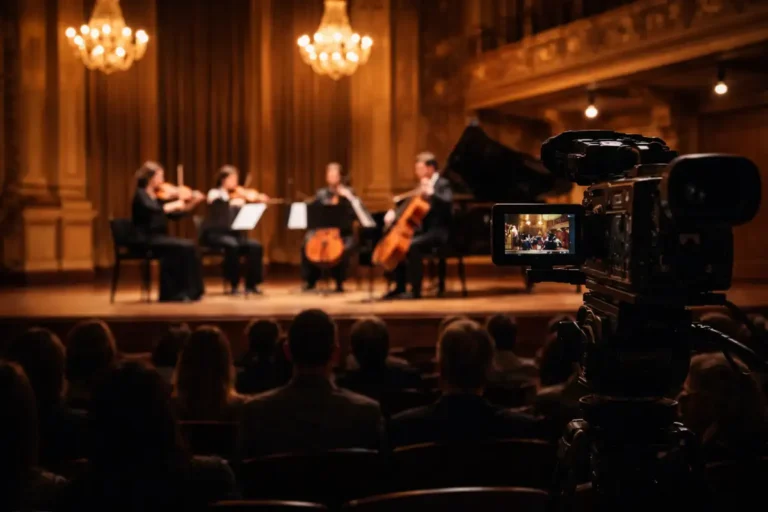
How to Film a Concert — Step by Step Guide
Filming a concert is not something you figure out on the day. A live performance happens once — there are no retakes, no second angles you can grab later, and no way to fix a missed moment in editing. If the audio is poorly captured, no amount of visual polish will save it. If only one camera was rolling, the edit will feel flat regardless of how good the performance was.
This guide walks through the full process of getting a concert filmed professionally — from the first planning decisions through to the finished video in your hands. It is written for concert organizers, musicians, ensemble managers, and venue coordinators who want to understand what is actually involved, step by step, so they can plan properly and get a result that does the performance justice.
Whether you are filming a classical recital in a Budapest church, a jazz set at a cultural venue, a chamber concert at a festival, or a full orchestral performance in one of Hungary’s major halls — the process follows the same essential steps.
Quick Answer
Filming a concert professionally involves seven key steps:
- Define your goals and deliverables.
- Find a videographer with concert-specific experience.
- Plan camera positions based on ensemble size and venue.
- Arrange professional audio recording separate from camera microphones.
- Prepare the venue and share the program in advance.
- Capture the performance with a multi-camera setup, and.
- Edit, synchronize audio, and deliver the finished video.
What Does It Take to Film a Concert Properly?
Concert filming sits in a category of its own. Unlike a corporate event or a conference, where the camera can reposition between sessions and the sound is mostly speech, a concert is continuous, musically complex, and unforgiving. The lighting is designed for the audience, not for cameras. The sound is the entire point of the event. And the production crew needs to be invisible — no visible movement, no noise, nothing that pulls the audience out of the music.
Genre adds another layer. Filming a string quartet is a different discipline from filming a big band. A solo piano recital has its own visual rhythm that does not apply to an orchestral symphony. A jazz performance involves improvisation, physical interaction between musicians, and spontaneous energy that the camera work needs to respond to in real time. Knowing the music — its structure, its dynamics, its turning points — is what separates a concert videographer from someone who happens to own a camera.
The seven steps below cover the process from start to finish.
Step 1 — Define Your Goals and Deliverables
Before anything else, clarify what you want the concert video for. This shapes every decision that follows — how many cameras are needed, how the audio is recorded, how the edit is structured, and what the final budget looks like.
Common goals include:
A full concert archive — a complete, multi-camera film of the entire performance with professional audio. This is the definitive record. Musicians use it for portfolios. Ensembles use it for grant applications and agency submissions. Venues and festivals use it to document their programming.
A highlight reel — a condensed three-to-five-minute edit capturing the energy and best moments of the event. This is what you share on social media, send to sponsors, embed on your website, or use to promote future concerts.
Individual pieces or movements — especially valuable for classical musicians who need separate recordings of specific works for competition entries, audition tapes, or online presence.
Short promotional clips — fifteen-to-sixty-second cuts formatted for Instagram, YouTube Shorts, or similar platforms. Quick to produce from existing footage and effective for post-concert visibility.
If you also need event photography, decide this now. Booking photography alongside videography from the same production team avoids coordination headaches and ensures the photographer and camera operators stay out of each other’s frames.
The clearer you are about what you want delivered, the more accurately a videographer can plan and quote the project.
Step 2 — Find the Right Concert Videographer
This is the step where most problems either start or are prevented entirely.
A videographer who is excellent at corporate events, weddings, or brand content may have no relevant experience filming live music. The skill sets are genuinely different. Concert filming requires musical awareness — the ability to anticipate a solo entrance, feel when a movement is building toward a climax, and know when to hold a wide shot versus cutting to a close-up. None of this can be improvised on the spot.
When evaluating a videographer, look at their portfolio first. You want to see concert-specific work — ideally in your genre. If you are organizing a classical performance, a showreel full of nightclub footage or corporate interviews tells you nothing about whether they can film a string quartet or a piano concerto.
Ask about their multi-camera capability. A single camera produces a static, single-angle document that is difficult to edit into anything engaging. Multiple cameras — typically two to five, depending on the ensemble — give the editor the angles needed to create a dynamic, visually varied film.
Ask how they handle audio. This is the single most revealing question. A concert specialist will talk about mixing desk feeds, dedicated recording microphones, audio synchronization in post-production, and dynamic range. A generalist might say the camera microphone is fine. It is not — not for music.
If they have experience working in Budapest venues — concert halls, churches, cultural centers, festival stages — that is a practical advantage. They will already know the common constraints: where cameras can and cannot go, how the house lighting behaves, where the power outlets are, and how to coordinate with venue management.
Step 3 — Plan Your Camera Setup
Camera count is not about more being better for its own sake — it is about having enough angles to edit a finished film that holds the viewer’s attention and faithfully represents the performance.
Here is a practical starting framework:
Solo recital (piano, voice, solo instrument): two cameras. A wide shot covering the full stage and performer, plus a closer camera for hands, face, and expressive detail. Two angles is the minimum needed for a watchable edit.
Chamber ensemble or jazz combo (2–5 performers): two to three cameras. The wide shot captures the group dynamic. A second camera isolates the lead or soloist. A third provides flexibility — audience perspective, instrument close-ups, or a side angle that shows performer interaction.
Full orchestra or large ensemble: three to five cameras. A centered wide shot is essential and usually unmanned (locked on a tripod). Additional cameras — some operated, some static — cover the conductor, soloists, principal players, and section details.
Camera positions depend on the venue. In a traditional concert hall with raked seating, a centered camera at audience level and a side camera on a balcony can work well. In a flat-floor church, options are more constrained. In a jazz club, intimacy is part of the aesthetic and cameras can be closer.
The videographer should propose a camera plan based on the venue layout, ensemble size, and program. If they cannot explain where each camera will go and why, that is a concern.
For a deeper breakdown, see our upcoming guide: How many cameras do you need for a concert video?
Step 4 — Arrange Professional Audio Recording
If there is one step in this entire process that separates a professional concert film from an amateur one, it is this.
A camera’s built-in microphone records everything in the room — the music, the audience coughing, the air conditioning hum, the reverb bouncing off the walls — and compresses it all into a flat, harsh track that strips the performance of its dynamics. For speech at a conference, this might be acceptable. For music, it is not.
Professional concert audio is recorded separately from the cameras, using one or more of these methods:
Direct feed from the mixing desk. If the venue has a sound system with a mixing desk, the videographer can take a direct audio output. This gives a clean, isolated signal — but it may lack the natural room sound that gives a live performance its character.
Dedicated recording microphones. Microphones placed near the stage, overhead, or at strategic positions in the hall capture the performance with the natural acoustics of the space. This is standard practice for classical and acoustic music recordings.
A combination of both. The best approach for most concerts. The desk feed provides clarity and definition. The room microphones capture ambiance and natural reverb. Mixed together in post-production, they produce an audio track that sounds both detailed and alive.
Classical music and jazz are especially demanding because of their dynamic range — the distance between the softest pianissimo and the loudest fortissimo passage. Camera microphones compress this range, destroying exactly what makes the performance expressive. Professional recording equipment preserves it.
The audio track is synchronized with the video footage in post-production — a standard process that requires precision but produces a fundamentally superior result.
For more on this critical subject, see our upcoming guide: Why audio quality matters more than video in concert films.
Step 5 — Prepare the Venue
Good preparation on the venue side prevents the majority of problems that can go wrong during a concert filming. A few practical steps make a significant difference:
Arrange a venue visit. If the videographer can see the space before the concert day — or at minimum receive detailed photos and a floor plan — they can plan camera positions, identify lighting issues, and confirm equipment logistics in advance rather than scrambling on the day.
Share the program and running order. Knowing what will be performed, in what order, by which musicians, and with what instrumentation allows the camera operators to plan their shot sequences. For classical concerts, sharing the score (or at least the movement structure) helps operators anticipate solo entrances, dynamic shifts, and climactic moments. A camera operator who knows that the oboe solo begins at bar 47 will capture it. One who does not will be pointing elsewhere.
Discuss lighting. Stage lighting in concert halls and churches is designed for the audience’s experience, not for cameras. In some venues, small adjustments — a warmer color temperature, a slightly brighter overall wash, reducing a harsh backlight — can significantly improve the video without changing the audience experience. This conversation is worth having with the venue’s technical team before the event.
Confirm camera positions. Tripods need stable, unobstructed positions with clear sightlines. In venues with fixed pews, narrow aisles, or protected architectural elements, options may be limited. Confirm positions with venue management in advance.
Check power access. Cameras, monitors, and audio recorders need power. Verify that outlets are available near planned camera positions, or confirm battery operation is feasible for the full duration.
For a detailed preparation checklist, see our upcoming guide: How to prepare your venue for professional video recording.
Looking for a concert videographer with real experience?
Browse our portfolio to see multi-camera concert films, classical music recordings, and live event coverage from performances across Budapest and Europe.
Step 6 — The Day of the Concert
On the day, the production crew arrives well before the audience.
Setup begins with positioning cameras, mounting them on tripods, and confirming each angle covers what was planned. Audio recording equipment is set up and tested independently — levels are checked, the mixing desk feed is confirmed (if applicable), and microphone positions are verified.
If the venue permits, a brief test during a soundcheck or rehearsal is ideal. It gives the camera operators a chance to see the performers on stage, adjust framing, and confirm that lighting conditions match what was expected.
During the performance itself, the videographer’s job is to follow the music. Operated cameras track the action — moving to the soloist during a solo passage, widening during a tutti section, finding the conductor’s cue at a critical entrance. Static cameras hold their positions and provide the editing safety net: the wide shot that is always available as a fallback.
The entire production should be invisible to the audience. No visible movement behind cameras, no audible cues between operators, no equipment noise during quiet passages. In classical music especially, the production crew’s discipline during the performance is as important as their technical skill.
Step 7 — Post-Production and Delivery
After the concert, the real editing work begins.
All camera angles are imported, synchronized by timecode or audio waveform, and laid into a multi-camera editing timeline. The editor reviews the entire performance and selects the best angle for each moment — the shot that tells the musical story most effectively.
The separately recorded audio track is synchronized with the video. If both a mixing desk feed and room microphones were used, they are mixed together to balance clarity with natural acoustics. The audio is then mastered for consistent volume, tonal balance, and dynamic range.
Video is color-corrected so that all camera angles look consistent — matching exposure, white balance, and color tone across cameras that may have been in very different lighting positions.
From the finished full-length film, shorter deliverables are cut: the highlight reel, individual pieces or movements, and promotional clips.
Typical turnaround is two to four weeks, depending on the length of the concert and the scope of deliverables. If you have a time-sensitive deadline — a press release, a social media push, a festival submission — discuss it before the event. Rush delivery is usually possible but involves additional cost.
What You Should Receive at the End
Before booking, agree on exactly what will be delivered. A clear list prevents misunderstandings and ensures you get everything you need from the production.
Typical deliverables for a professionally filmed concert include:
Full-length concert film — the complete performance, multi-camera edited, with synchronized professional audio, color-corrected. This is your archive-quality record.
Highlight reel — a three-to-five-minute edit capturing the best moments and atmosphere. The primary asset for sharing, promotion, and online presence.
Individual pieces or movements — each work delivered as a separate file. Essential for musicians building portfolios, applying to competitions, or submitting grant documentation.
Short promotional clips — formatted for Instagram, YouTube Shorts, or other platforms. Quick-turnaround social content.
Event photography — if photography was booked alongside video, a set of high-resolution edited images covering the performance, venue, and key moments.
Confirm file formats (typically MP4 for video, WAV for audio masters, JPEG for photos), resolution (1080p or 4K), and delivery method (download link or hard drive). Clarify usage rights — can you publish the video on your own channels, share it with sponsors, submit it to festivals, and use it in future marketing? Get this in writing.
Common Mistakes When Hiring a Concert Videographer
Hiring a generalist. A videographer who shoots weddings, real estate tours, and corporate interviews may be talented — but concert filming requires a specific set of instincts around music, performer awareness, and unobtrusive camera work. Always ask for concert-specific portfolio samples.
Ignoring audio entirely. This is the most costly mistake. If you end up with beautiful 4K footage and tinny, echoey audio captured by a camera-mounted microphone, the video will be essentially unusable for anything beyond silent social media clips.
Booking too late. If you contact a videographer two days before the concert, there’s no time for a venue visit, programme review, or proper planning. Three to four weeks of lead time is a reasonable minimum. For larger productions or peak season events, book earlier.
Not sharing the programme. A videographer who walks into a concert without knowing the programme is guessing — when to cut, where to look, who will solo. The result is reactive and unpolished instead of intentional.
Comparing quotes without context. A quote for one camera with no separate audio recording is not comparable to a quote for three cameras with professional audio capture and a highlight edit. Understand what each quote includes before choosing based on price.
Forgetting about usage rights. Some videographers retain ownership of the footage unless you negotiate otherwise. If you need the video for broadcast, distribution, or long-term archival use, make sure the contract covers it.
Concert Videography Cost Factors in Budapest
Concert videography pricing varies significantly based on several real factors:
Camera count and crew size. A single-camera shoot with one operator costs less than a three-camera setup requiring additional equipment and potentially additional crew.
Audio recording scope. Professional audio capture — external microphones, a dedicated recorder, post-production mixing — adds to the budget but is essential for any recording you plan to publish.
Event duration. A 45-minute recital requires less time than a two-hour orchestral programme. Setup and teardown time also counts — a three-hour event may involve five or more hours of on-site time.
Post-production. Editing a multi-camera concert video is time-intensive. Full concert edits, highlight videos, individual piece exports, colour grading, and audio mixing all factor into the final cost. The more deliverables you need, the more editing time is involved.
Travel. Budapest-based productions are straightforward. Events in Vienna, elsewhere in Hungary, or across Europe involve travel costs — transport, potential accommodation, and additional time.
For a fuller discussion of pricing: [What does concert videography cost in Budapest?]
You can also review our current pricing and packages directly.
When to Book a Concert Videographer in Budapest
When you’re ready to hire a concert videographer in Budapest, reach out at least three to four weeks before the event. This allows time for a proper conversation about the programme, a venue visit if needed, and production planning.
When you make your inquiry, include:
- The date, time, and venue
- The type of event (concert, recital, festival performance, etc.)
- The ensemble or performers
- The approximate programme length
- What you want the video for (archive, promotion, social media, broadcast, competition submission)
- Any specific requirements or restrictions
A good videographer will ask follow-up questions — about the venue, the lighting, the audio situation, and the programme structure. If someone just quotes a price without asking any of these, that’s worth noting.
Have an upcoming concert?
Tell us about your performance — the date, venue, ensemble, and what you need — and we will put together a clear, specific production plan and quote.
Frequently Asked Questions
Yes — and this is one of the most practical things you can do to improve the final result. When the camera operators know the program, the movement structure, and where the solos and climaxes fall, they can anticipate and capture those moments instead of reacting to them after the fact. For classical performances, sharing the score is even more helpful.
Professional concert audio is recorded separately from the cameras — either from a direct mixing desk feed, from dedicated microphones placed near the performers, or a combination of both. The audio track is then synchronized with the video in post-production. Camera microphones alone are not sufficient for music recording.
Typical turnaround is two to four weeks, depending on the concert length and the scope of deliverables (full film, highlight reel, individual pieces, promotional clips). Rush delivery for time-sensitive deadlines is usually available at additional cost.
It depends on the ensemble and venue. A solo recital needs at least two cameras. A chamber or jazz group works well with two to three. A full orchestra typically requires three to five for proper multi-angle coverage. More cameras give the editor more flexibility to create a dynamic, engaging film.
Pricing depends on camera count, event duration, audio recording complexity, editing scope, and deliverables. Travel outside Budapest (to Vienna or other cities) also affects cost. The best approach is to share your event details and request a specific quote. You can also review our pricing overview.
If you need both still images and video, booking them from the same production team simplifies logistics. The photographer and camera operators can coordinate positions so they do not interfere with each other during the performance. Photography is a complementary service — it gives you a different type of asset (high-resolution images for press, social media, print) alongside the video.