
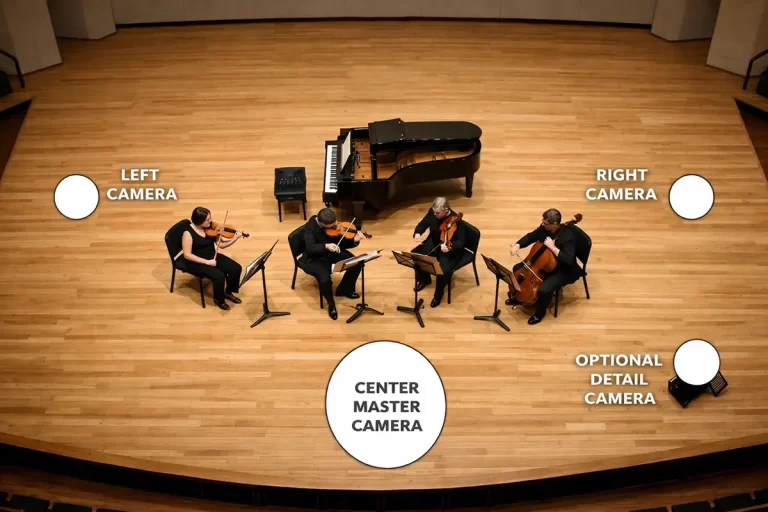
Best Camera Layout for Chamber Music Ensembles
Chamber music usually works best with a three-camera layout: one centered wide master shot and two balanced side angles. For most performances, the best camera layout for chamber music ensembles is this kind of simple, well-balanced setup. It gives a clear view of the ensemble, preserves the visual relationships between players, and creates enough editing flexibility without making the filming feel intrusive.
In practice, the right layout depends on the ensemble type, the venue, the audience situation, and the final deliverables. A string quartet in a recital hall is not the same as a piano trio in a church or a chamber performance that also needs short promotional clips.
This guide explains what usually works best, when three cameras are enough, when a fourth camera is worth adding, and what musicians, organizers, and venues should consider before booking chamber music videography in Budapest, Vienna, or similar European concert settings.
Quick Answer
For most chamber music ensembles, the best camera layout is:
1 centered wide master camera
1 left-side medium angle
1 right-side medium angle
This setup is usually the best balance of:
full-ensemble visibility
natural musical coverage
editing flexibility
discreet production in front of an audience
A fourth camera becomes useful when the ensemble includes piano, when tighter detail coverage matters, or when the project also needs teaser clips, promo edits, or highlight material.
What Is the Best Camera Layout for Chamber Music Ensembles?
A chamber music setup works best when it follows the logic of the performance rather than a generic event filming template. In most cases, the best camera layout for chamber music ensembles is one that keeps the full group visible, preserves musical interaction, and gives enough flexibility for editing without making the filming feel intrusive.
A good camera layout should do four things well:
Show the whole ensemble clearly
There should always be one reliable shot that shows the group as a complete musical unit. Without that, the final edit can lose structure very quickly.
Preserve musical interaction
In chamber music, players are constantly responding to each other through eye contact, breathing, posture, and phrasing. The camera layout should make those relationships visible.
Stay discreet in the room
Concert halls, churches, and cultural venues often have tight audience sightlines and limited camera positions. The setup should respect the event rather than dominate it.
Give enough edit flexibility without overcomplicating the filming
More cameras do not automatically improve the result. In many cases, a well-planned three-camera setup looks cleaner and feels more musical than an overbuilt production.
The standard 3-camera setup
For most chamber music ensembles, three cameras are the strongest default.
1. Centered wide master
This is the anchor shot. It should show the full ensemble and remain usable throughout the performance.
The master matters because it gives the editor a stable base and keeps the performance visually coherent. It also protects the edit when a side angle becomes less useful for a moment.
A good master shot is usually:
centered or close to centered
stable and locked off
wide enough to include the full group comfortably
framed with enough stage context to feel intentional
2. Left-side medium angle
This camera usually sits to the audience’s left and frames the ensemble from a moderate angle.
It helps the edit feel more dimensional and lets the viewer read interaction between players without going too tight too early.
3. Right-side medium angle
This balances the second camera and prevents the edit from leaning too heavily in one visual direction.
It also helps when one side of the stage is partially blocked by instruments, stands, or piano lid position.
Why this setup is usually the best answer
A three-camera chamber music layout gives you:
one stable full-performance shot
two edit-friendly angles
enough variation without visual clutter
a practical footprint for live audience settings
a clean workflow for full concert editing
For many concerts, that is exactly the right level.
When 4 cameras make more sense
A fourth camera becomes useful when the project needs more than clean documentation.
A fourth camera is often worth adding when:
the ensemble includes piano and keyboard detail matters
one featured player needs stronger visual emphasis
the client wants a full concert edit and short promo clips
the venue makes one side angle less useful than usual
the repertoire benefits from more visual detail
In a piano trio, for example, the piano can dominate the visual space and limit one of the side views. A fourth camera can solve that by covering keyboard detail or adding a tighter angle that complements the wider shots.
A fourth camera is also helpful when the final delivery includes:
teaser videos
highlight reels
short-form clips for musicians or venues
promotional edits for applications, websites, or social media
That is a different goal from simple archival coverage, and the camera plan should reflect it.
Need a clearer idea of what level of coverage fits your concert?
If you are comparing setup options for a recital, chamber concert, or cultural event, it helps to look at real examples and service structure first.
Useful next steps:
Best layout by ensemble type
The right layout changes with the group.
String quartet
A string quartet is one of the clearest cases for the standard three-camera approach.
A strong setup is usually:
one wide master
one side angle favoring first violin and viola
one side angle favoring second violin and cello
This gives enough visual variation while keeping the ensemble readable as one unit.
Piano trio
A piano trio often benefits from four cameras more than a string quartet does.
The reason is simple: the piano takes space, the lid affects sightlines, and hand detail may matter both musically and visually.
A useful layout is often:
one centered wide master
one left-side medium angle
one right-side medium angle
one detail or piano-focused camera
Duo
For violin and piano, cello and piano, voice and piano, or similar formats, three cameras are still often enough.
A typical layout is:
one wide master of both performers
one angle favoring the soloist
one angle favoring the pianist or second performer
Larger chamber ensemble
Once the group gets larger, the setup becomes more case-specific.
Stage depth, stand placement, instrument balance, and venue geometry start to matter more. In those situations, one additional detail camera may be justified.
Venue factors that affect camera placement
The ensemble alone does not decide the setup. The room matters just as much.
Many chamber performances in Budapest and Vienna take place in formal cultural venues such as Müpa Budapest, where camera positions and audience sightlines often need careful planning.
In Budapest, Vienna, and similar European venues, chamber performances often take place in recital halls, churches, cultural institutions, salons, small festival spaces, and historic interiors.
These venues often create practical limitations such as narrow aisles, restricted front-of-house space, audience proximity, blocked side positions, reflective acoustics, and limited lighting control.
A layout that looks right on paper may fail in the actual room if one camera blocks sightlines or one angle is limited by piano lid direction, stage geometry, or audience placement. In real concert conditions, the best camera layout for chamber music ensembles has to be adapted to the venue as well as the ensemble.
This is why chamber music videography is not only about camera count. It is about camera placement discipline.
Why audio matters just as much
A chamber music film can survive a modest visual setup. It cannot survive weak audio.
Even on a camera-layout page, audio has to be part of the discussion because camera placement and microphone placement affect each other.
For serious classical or jazz performance coverage, professional audio recording is usually necessary. Camera audio alone is rarely enough for a result that feels credible.
This matters for two reasons:
Sound determines perceived quality
Even if the visuals are clean, poor audio makes the entire production feel weak.
Audio planning affects camera planning
Microphones, stands, cables, and safe placement zones have to work together with the camera layout. The strongest productions treat picture and sound as one coordinated system.
If you are evaluating providers, do not only ask how many cameras are included. Also ask how the concert audio is being captured and delivered.
Common mistakes in chamber music filming
Most weak setups fail in predictable ways.
Using too few useful angles
One strong master shot and two weak extra angles often leads to a flat edit.
Going too tight too early
If the side cameras are framed too tightly, the final video loses ensemble context and starts to feel fragmented.
Ignoring piano lid direction or music stand blockage
This is especially common in piano trios and mixed chamber setups. On paper the angle looks fine. In practice, the important visual line is blocked.
Moving cameras too much
Chamber music usually benefits from restraint. Excessive movement, visible repositioning, or aggressive reframing can weaken the formal character of the performance.
Treating audio as secondary
This is the biggest technical mistake. Good chamber music coverage depends on sound just as much as picture.
When photography or promo clips change the setup
Photography should not be forced into every concert booking, but in some cases it changes the production plan.
If the client also needs concert photography, it helps to define the main priority in advance:
live performance documentation
rehearsal photography
pre-concert portraits
promotional stills for press or program use
For quiet chamber repertoire, rehearsal stills or pre-concert photography are often more practical than active photography during the performance.
The same applies to promo deliverables.
If the booking also includes:
teaser videos
promo clips
short social edits
venue recap material
then one extra camera may be justified because the edit will need more detail material than a straightforward full-concert delivery.
How to choose the right setup for your concert
The best setup depends on the real purpose of the video.
For a simple archival recording
Three cameras are often enough.
For artist promotion
A fourth camera may be useful, especially if clips will be cut for websites, grant applications, or social media.
For piano-based chamber work
A four-camera setup is often more flexible.
For formal concert hall documentation
A disciplined three-camera layout is often the cleanest choice.
For mixed documentation and marketing use
The production should be planned around both needs from the beginning, not upgraded halfway through.
Before booking, it is worth clarifying:
ensemble type
venue
audience presence
camera count
audio method
photography needs
final deliverables
turnaround expectations
If you also need budget clarity, review the Pricing page early rather than adding scope later.
Final thoughts
For most chamber music ensembles, the best camera layout is still the simplest strong answer:
one centered wide master
one left-side medium angle
one right-side medium angle
That setup usually gives the best balance of musical clarity, editing flexibility, and practical discretion in real concert conditions.
A fourth camera only becomes necessary when the ensemble, venue, or final deliverables clearly justify it.
For chamber performances in Budapest, Vienna, and similar European venues, the difference is rarely about using the most equipment. It is about using the right layout for the music, the room, and the intended result.
If you want to keep the focus keyword one more time in the conclusion, use this version instead of the last paragraph:
In most live recital settings, the best camera layout for chamber music ensembles is a disciplined three-camera setup planned around the music, the room, and the intended final delivery.
Planning a concert in Budapest or Vienna?
Dowlaty Productions provides concert videography for chamber ensembles, classical performances, cultural events, and related live productions.
If you want a practical recommendation for your ensemble, venue, and intended deliverables, you can explore the portfolio, review the service approach, or request a quote based on your event details.
Frequently Asked Questions
Yes, but the result will be a single static recording with no editing flexibility. One camera is acceptable for simple documentation purposes, but for any professional or promotional use, a minimum of two cameras is strongly recommended.
It can. Chamber music is performed at very low volumes and even subtle camera noise — autofocus motors, lens adjustments, or operator movement — can contaminate the audio. Always use silent or near-silent camera operation during recording, and coordinate camera positions with the audio engineer.
Three cameras is the standard setup for filming chamber music ensembles. One wide master shot in the center and two offset medium angles provide full coverage and clean editing options. Two cameras can work in very small venues, and a fourth is worth adding for larger ensembles or featured solo passages.
Ideally no. Cameras should be positioned discreetly so they do not distract performers or audience members. In smaller venues this requires careful planning — tripods at the sides of the room and a center camera positioned behind or between audience rows.
A three-angle setup works best: one center wide shot capturing the full quartet, and two offset medium angles from roughly 45 degrees on each side. This gives you coverage of individual players and natural interaction between performers.
The main camera should be placed centrally, directly facing the ensemble at a slight distance to capture all performers in a single wide shot. This is your master shot and the editorial backbone of the entire recording.